



The year 2024 marked both the first full year of operation of the Observatory for the Ombudsman of the Citizen and the Enterprise (symparastatis.gr) and the beginning of the new local government term (2024–2028). Among the 212 Municipalities and 13 Regions legally obliged to elect an Ombudsman under Law 3852/2010, compliance levels varied significantly, despite a notable increase in activity compared with previous periods. The present report of the Observatory assesses the degree to which Local Governments complied with this obligation.
Changes from the Previous Local Government Period
The new local government period introduced two key differentiations to the institution of the Ombudsman of the Citizen and the Enterprise compared with the period 2019–2023.
- Reduction in the number of obligated Municipalities: According to the population changes recorded by the 2021 General Population Census, the Municipalities with fewer than 20,000 inhabitants now amount to 178. Specifically, there were 10 Municipalities that fell below the threshold of 20,000 inhabitants and 2 Municipalities that exceeded it. Taking into account that one of the two Municipalities that exceeded it is an island Municipality (the Municipality of Naxos and Minor Cyclades) and was already obligated to select an Ombudsman of the Citizen and the Enterprise, the number of Municipalities that are no longer required to elect an Ombudsman based on the latest Population Census amounts to 9. Thus, the Municipalities that are obligated to elect an Ombudsman of the Citizen and the Enterprise now stand at 212, down from 221 in the previous local government period.
- Changes in the institutional framework for election: According to Law 4873/2021, Article 51(3), it is clarified that the required majority of three fifths (3/5) of the present members of the Municipal Council for the election of an Ombudsman concerned the municipal period 2019–2023, while paragraph 1 of the same Article reinstates the majority of two thirds (2/3) of the total number of Municipal Council members for the new local government period 2024–2028. In this way, the broad consensus that had been stipulated in the “Kallikratis” reform for the selection of an Ombudsman returns, and it is recognized as the main reason for the inability of Local Government Organizations to elect an Ombudsman. Specifically, of the 37 Municipalities that did not manage to select an Ombudsman of the Citizen and the Enterprise after the relevant discussion in the Municipal Council in 2024, in 35 cases it was not possible for any of the candidates to secure the required majority, while in the other two (2) cases no candidacy was submitted.
The Institution of the Ombudsman of the Citizen and the Enterprise in the Municipalities in 2024
The year 2024 was marked by intense activity on the part of Local Government regarding the activation of the institution of the Ombudsman of the Citizen and the Enterprise in their area of responsibility. Thus, of the 212 obligated Municipalities, 109 proceeded to determine the content of the call for applications for the selection of an Ombudsman. Of these, 104 subsequently published the relevant call, while 85 included the item of selecting an Ombudsman in the agenda of a Municipal Council meeting. Following one or two secret ballots, 52 Municipalities succeeded in electing an Ombudsman of the Citizen and the Enterprise.
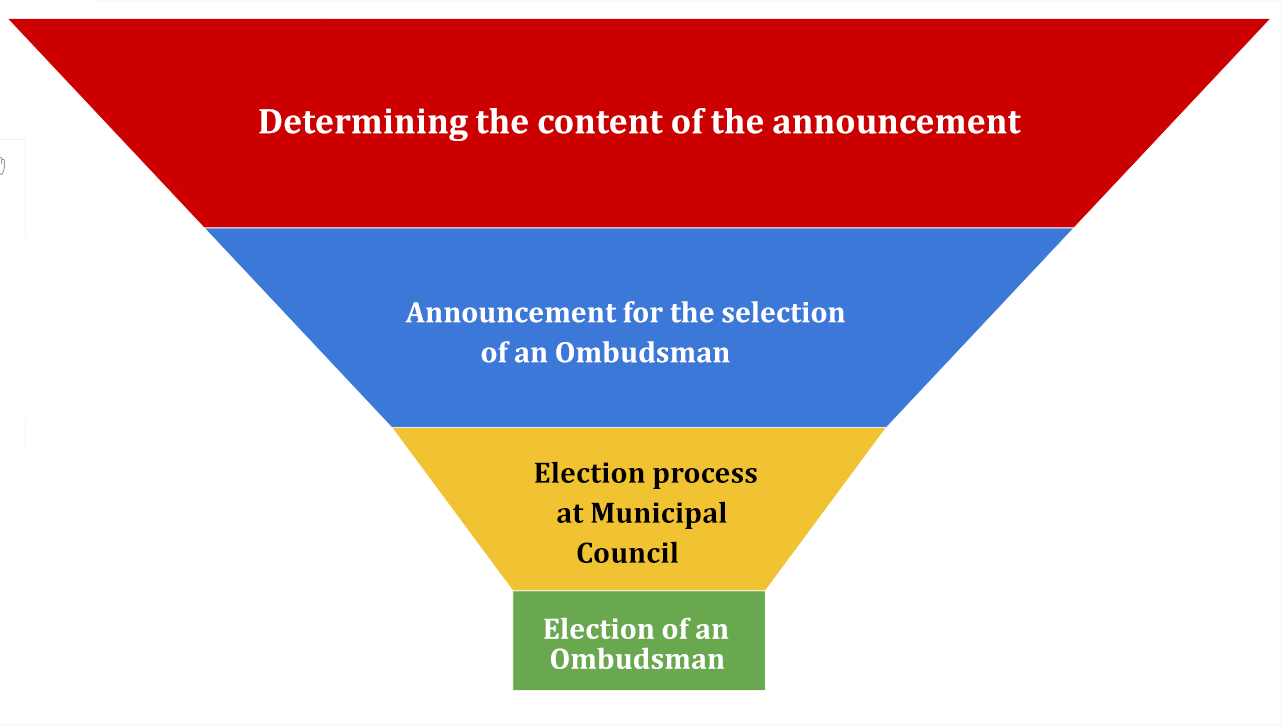
Of course, considering that this is a dynamic process, these numbers may change in the new year, as there are Municipalities that have indeed published a call for the position but have not yet proceeded to discussion and voting for the selection of an Ombudsman of the Citizen and the Enterprise. Among these is also the largest Municipality in the country, the Municipality of Athens, which placed -and then postponed- the item of selecting an Ombudsman of the Citizen and the Enterprise on the agenda of the Municipal Council three times, in July, September, and November 2024.
It is also worth noting that deviations were observed in some Municipalities at each stage of the election process, in the sense that they did not comply with certain requirements of the law. Some characteristic cases are:
- Municipality of Serifos: During the meeting of the Municipal Council on 30-03-2024, it decided not to determine the content of the act announcing the position of the Ombudsman of the Citizen and the Enterprise, with the argument that “this institution is not necessary”. This is, of course, a decision that undermines the principle of legality, given that the Municipality of Serifos is obligated by law to proceed with the procedures for selecting an Ombudsman of the Citizen and the Enterprise. Consequently, the Decentralized Administration of the Aegean annulled this decision, following a special administrative appeal submitted by a member of the Municipal Council of the Municipality of Serifos.
- Municipality of Drama: The decision regarding the selection of an Ombudsman of the Citizen and the Enterprise was annulled by the Decentralized Administration of Macedonia–Thrace because, when it was issued, the essential formality of the secret ballot procedure had not been observed. In the repeat of the election process that took place at a subsequent meeting of the Municipal Council, the same Ombudsman of the Citizen and the Enterprise was elected again.
- Municipality of Florina: Although it selected an Ombudsman of the Citizen and the Enterprise, it appears that this person subsequently resigned, as they were at the same time an alternate member of the Municipal Council and chose to take up the vacant seat that arose from the death of a Municipal Councillor. It is noted that the Municipality did not proceed to publish any act concerning either the resignation of the Ombudsman of the Citizen and the Enterprise or the swearing-in of the same individual as a Municipal Councillor.
In any case, the number of Municipalities that managed to select an Ombudsman of the Citizen and the Enterprise seems to have largely stabilized, as there are few Municipalities for which discussion and voting on the selection of an Ombudsman is still pending at an upcoming Municipal Council meeting. Therefore, the number of 52 Municipalities that have “activated” the institution of the Ombudsman of the Citizen and the Enterprise is not expected to change significantly in the new year. It is worth noting at this point that, although this number is higher than the corresponding numbers of Municipalities that selected an Ombudsman during the three previous local government periods, it nonetheless remains low in relation to the total number of obligated Municipalities. In other words, while more Ombudspersons have been elected compared with previous terms, this number corresponds to only 24.5% of the total number of Municipalities that are required to elect an Ombudsman of the Citizen and the Enterprise.
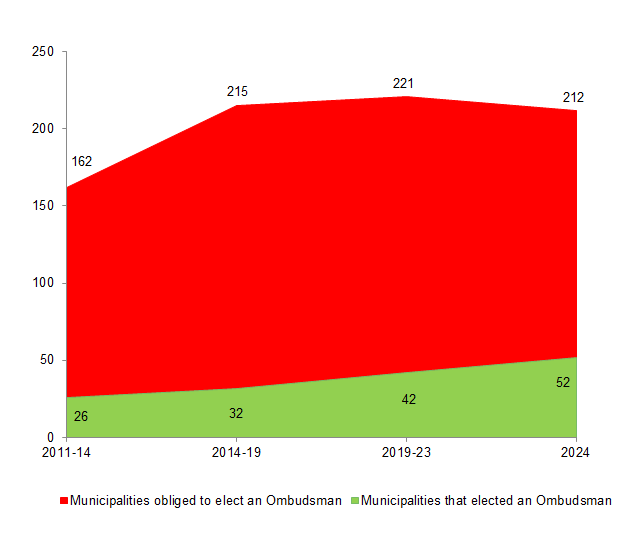
Nevertheless, 21 of the 52 Municipalities that selected an Ombudsman of the Citizen and the Enterprise during the new municipal term had also managed to select one in the (at least) previous local government period (2019–2023), while five (5) Municipalities succeeded in electing an Ombudsman for the first time.
Municipalities that Elected an Ombudsman of the Citizen and the Enterprise in 2024
|
Agia Paraskevi |
Lavreotiki |
|
Agioi Anargyroi–Kamatero |
Mykonos |
|
Alexandria |
Mytilene |
|
Alexandroupoli |
Nea Ionia |
|
Alimos |
Nea Filadelfeia–Nea Chalkidona |
|
East Samos |
Paggaio |
|
Andravida–Kyllini |
Peania |
|
Argos–Mycenae |
Paionia |
|
Vari–Voula–Vouliagmeni |
Palaio Faliro |
|
Galatsi |
Paxoi |
|
Delta |
Paros |
|
Drama |
Pavlos Melas |
|
West Achaea |
Piraeus |
|
West Lesvos |
Pella |
|
Elliniko–Argyroupoli |
Perama |
|
Eordaia |
Poros |
|
Thessaloniki |
Pylaia–Chortiatis |
|
Sacred City of Messolonghi |
Rafina–Pikermi |
|
Ioannina |
Rhodes |
|
Kalamata |
Serres |
|
Kallithea |
Sifnos |
|
Kalymnos |
Syros–Ermoupoli |
|
Katerini |
Filothei–Psychiko |
|
Kimolos |
Halki |
|
Kozani |
Hersonissos |
|
Komotini |
Oraiokastro |
Another interesting element is the number of Municipalities that this year, for the first time, took steps to activate the institution of the Ombudsman of the Citizen and the Enterprise. In total, these are 22 Municipalities that initiated the process, either remaining at the stage of determining the content of the call for applications or going as far as electing an Ombudsman of the Citizen and the Enterprise. However, in contrast with the Municipalities that proceeded at least to determining the content of the call and/or to publishing the actual call for the selection of an Ombudsman, there are also those Municipalities that did not take any action at all for the activation of the institution. These are 103 Municipalities, that is, approximately half (48.5%) of those that are required to select an Ombudsman of the Citizen and the Enterprise.
Municipalities that Did Not Undertake Any Procedure for the Selection of an Ombudsman of the Citizen and the Enterprise in 2024
|
Nestos |
Vrilissia |
Agistri |
|
Xanthi |
Glyfada |
Aegina |
|
Orestiada |
Dafni–Ymittos |
Kythera |
|
Ampelokipoi–Menemeni |
Heraklion (Attica) |
Troizinia–Methana |
|
Thermi |
Ilion |
Hydra |
|
Kordelio–Evosmos |
Kaisariani |
Ikaria |
|
Lagadas |
Keratsini–Drapetsona |
Fournoi Korseon |
|
Neapolis–Sykies |
Kifissia |
Chios |
|
Nea Propontida |
Korydallos |
Heroic Island of Psara |
|
Polygyros |
Lykovrysi–Pefki |
Agathonisi |
|
Grevena |
Marathon |
Amorgos |
|
Kastoria |
Markopoulo Mesogaias |
Anafi |
|
Larisa |
Nea Smyrni |
Andros |
|
Volos |
Pallini |
Antiparos |
|
Karditsa |
Papagou–Cholargos |
Astypalaia |
|
Tyrnavos |
Peristeri |
Heroic Island of Kasos |
|
Delphi |
Petroupoli |
Thira |
|
Thebes |
Spata–Artemida |
Ios |
|
Kymi–Aliveri |
Haidari |
Karpathos |
|
Levadeia |
Agios Nikolaos |
Kea |
|
Chalkida |
Ierapetra |
Kythnos |
|
Patras |
Siteia |
Kos |
|
Agrinio |
Phaistos |
Leipsoi |
|
Aigialeia |
Chania |
Leros |
|
Ilida |
Thasos |
Megisti (Kastellorizo) |
|
Pyrgos |
Samothraki |
Milos |
|
Corinth |
Alonissos |
Nisyros |
|
Monemvasia |
Skyros |
Serifos |
|
Sikyon |
Central Corfu and Diapontia Islands |
Sikinos |
|
Sparta |
Zakynthos |
Symi |
|
Trifylia |
Ithaca |
Tilos |
|
Agia Varvara |
Lixouri |
Folegandros |
|
Aigaleo |
Meganisi |
Gavdos |
|
Maroussi |
South Corfu |
|
|
Aspropyrgos |
Sami |
It is recalled that in March the Observatory published a list of the most frequent “misconceptions” regarding the institution of the Ombudsman of the Citizen and the Enterprise, based on the most common reservations, concerns or even objections that are often publicly expressed, for example by Municipal or Regional Councillors, and which appear to be based on incorrect perceptions regarding the role and operation of the institution. It is noted that this list of “frequent misconceptions” has emerged as the Observatory’s most visited article.
Nonetheless, the reasons why many of these Municipalities choose not to implement this specific law, given moreover that they are indirectly afforded such a possibility due to the absence of any sanction in the event of non-compliance, are likely not limited to a possible lack of interest or to some incorrect perception about the institution. As seen above, among the Municipalities that did not activate the institution, 44 of them (42.7%) are island Municipalities, often small in population and, consequently, with limited human resources and financial means - factors that probably play an important role in their capacity to activate the institution of the Ombudsman of the Citizen and the Enterprise.
Finally, certain demographic data are also of interest, such as the gender of the Ombudspersons. Specifically, among the 52 Ombudspersons elected in 2024, 27 are women (52%). This is a positive development as regards the balanced representation of genders in this institution, bearing in mind that the corresponding share of elected female Ombudspersons overall for the period 2011–2023 was only 22%.
The Institution of the Ombudsman of the Citizen and the Enterprise in the Regions in 2024
The number of Regions that selected a Regional Ombudsman of the Citizen and the Enterprise in 2024 is seven (7). This is a number that does not differ from the average that was formed during the previous local government periods, since 7 Regions had also selected an Ombudsman of the Citizen and the Enterprise in the previous period 2019–2023. It is worth noting that 6 of the 7 Regions that selected an Ombudsman of the Citizen and the Enterprise in the new local government period that began in 2024 had also selected one during the previous period. This fact may indicate, on the one hand, the familiarity that is cultivated with the institution of the Ombudsman of the Citizen and the Enterprise and its operation over time, and, on the other hand, the importance that is attached to the continuation of this institution based on the benefits it has provided in the past to Local Government.
Regions that Selected a Regional Ombudsman of the Citizen and the Enterprise in 2024
- Region of Central Macedonia
- Region of Western Greece
- Region of Western Macedonia
- Region of Eastern Macedonia and Thrace
- Region of South Aegean
- Region of North Aegean
- Region of Epirus
Assessment of the Observatory’s Operation
The Observatory for the Ombudsman of the Citizen and the Enterprise began its pilot operation in November 2023, so as to be in full operation by January 2024, when the new local government period (2024–2028) commenced. Thanks to the use of RSS feeds, it had the ability to continuously receive and record, almost in real time, acts of Local Government related to the institution of the Ombudsman of the Citizen and the Enterprise, which were published either on the “Diavgeia” transparency website, or on the websites of Municipalities and Regions, or even in online media outlets.
Using as its main point of reference the acts uploaded to Diavgeia, the Observatory essentially reuses open data, updating the respective pages of the Municipalities and Regions with the actions they have taken regarding the institution, rephrasing these acts in a more concise, simple and comprehensible manner. At the same time, it records these actions on a central updates page, in the form of a calendar, so that, on the one hand, they are all gathered in one place for ease of reference, and, on the other hand, they are captured in their temporal dimension, sorted by month and in chronological order.
However, the Observatory did not limit itself to recording this information, but from the outset sought to inform and raise the awareness of both civil society and Local Government regarding the institution and its operation. Its main activities in this direction were the following:
Letters
- First open letter to 212 Municipalities regarding the selection of an Ombudsman of the Citizen and the Enterprise
- Second open letter to 131 Municipalities regarding the selection of an Ombudsman of the Citizen and the Enterprise
- Congratulatory letters to 42 Ombudspersons, through which the Observatory made known its operation and its objectives
- Letters to 17 Municipalities that had elected an Ombudsman of the Citizen and the Enterprise but had not yet published his or her contact details on their websites
Presentations
- Presentation of symparastatis.gr at the 2nd WeOpenGov Forum
- Presentation of the Observatory at an event of the Municipality of Dionysos on “Digital Governance – The Role of the Ombudsman of the Citizen and the Enterprise in Public Administration”
- Presentation of the Observatory at the FOSSCOMM 2024 Conference
Articles
- “The Ombudsman of the Citizen and the Enterprise in the Municipalities and Regions from 2011 to the Present”: a concise assessment of the implementation of the institution during the first three local government terms, including data for the new local government period (2024–2028).
- “Frequent ‘misconceptions’ about the Ombudsman of the Citizen and the Enterprise”: a list of common ‘misconceptions’ identified by the Observatory, which it seeks to address with as simple and well-documented answers as possible.
- “Advocate, Mediator or Ombudsman? The Institution of the Ombudsman in Europe and Greece”: an analysis that was initially published by the Hellenic Society for International and European Affairs (ODETH), outlining the history and evolution of the institution of the Ombudsman, from which the institution of the Ombudsman of the Citizen and the Enterprise is derived.
In parallel, the Observatory is gradually developing a series of new features and functions, which were presented in brief for the first time at the FOSSCOMM 2024 Conference in Thessaloniki and concern, among other things:
- Translation into English of at least the basic information of the website, so that the Observatory may be disseminated as a good open-government practice beyond Greece’s borders.
- Creation of a “members’ area” for Ombudspersons and for the Ombudsman Network. In order for the Observatory to contribute to better organization and cooperation among elected Ombudspersons and, consequently, to the reactivation of the Ombudsman Network, it has, on the one hand, created a category dedicated to the Network where announcements, news and events published by the Ombudsman Network are posted, and, on the other hand, it is developing a “members’ area” on the Observatory website, where access will be reserved exclusively for elected Ombudspersons, offering functionalities such as holding teleconferences and operating a private forum within the secure environment of the Observatory.
The above assessment of the activity of the Observatory does not include (as it was not considered appropriate to systematically record them) the large number of telephone calls and electronic messages received throughout the year from citizens, elected officials, Local Government staff, as well as prospective or current Ombudspersons, on matters related to the institution. It is noted, finally, that the Observatory is a zero-budget project, whose development and operation rely exclusively on the voluntary work of its administrator and on the valuable, likewise voluntary, contribution of a group of distinguished collaborators. These collaborators, through their time and advice, have significantly contributed to shaping the Observatory as it stands today.
In conclusion, instead of a conventional epilogue, this report closes with heartfelt thanks to all those who, in any way, supported the implementation of this initiative. At the same time, it expresses the hope that the new year will bring further broadening and deepening of cooperation, so as to strengthen the collective contribution towards open government. After all, the Observatory constitutes a proposal for open government, which does indeed take as its starting point the awareness-raising of citizens and Local Government regarding the institution of the Ombudsman of the Citizen and the Enterprise, but whose aim is the broader safeguarding of the fundamental principles that this institution serves: transparency, accountability, participation, effectiveness, sound administration, the protection of citizens’ right to information and, ultimately, the defense of the rule of law and democracy at a time when these appear to be weakening.
Ioannis Fytros
Founder of symparastatis.gr