Select your language
Select your language


The Ombudsmen of the Citizen and Enterprise at the level of municipalities and regions are an intermediary institution between citizens, businesses and the Municipality or the Region. The institution was introduced by Law 3852/2010 (Articles 77 and 179), reinstated by Law 4623/2019 (Article 7) and updated by Law 5314/2026 (Article 152). It aims at the early detection and effective treatment of phenomena of mismanagement, corruption or abuse of power, at ensuring the impartiality of municipal or regional authorities and at improving the services provided by Municipalities and Regions.
This website is an observatory about the implementation of the Ombudsman's institution in the Municipalities and Regions of Greece.
 Does not have an Ombudsman
 Has an Ombudsman
 Not obliged to have an Ombudsman
In municipalities with twenty thousand (20,000) inhabitants or more, by decision of the municipal council, an Ombudsman of the citizen and enterprise is selected. In municipalities with less than twenty thousand (20,000) inhabitants, by decision of the municipal council, an Ombudsman may be selected. In regions, by decision of the regional council, a regional Ombudsman of the citizen and enterprise is selected.
(Law 5314/2026, Article 152, par. 1)
According to the population changes recorded by the General Population Census of 2021, the Municipalities with more than 20,000 inhabitants now amount to 154.
Read more:
The Local Ombudsman institution
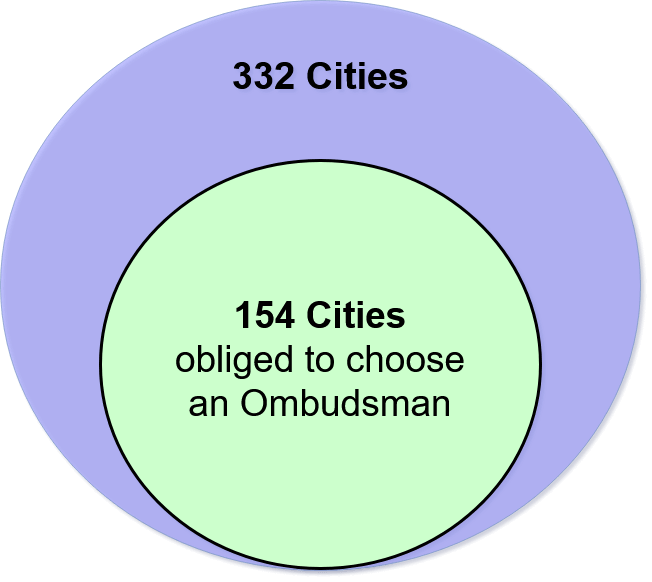
Because the implementation of the institution of the Ombudsman of Citizen and Enterprise admittedly has not been adopted to the expected extent during the first three terms since its institutionalization by Law 3852/2010. In the last term 2019-2023, only 19% of the Municipalities that had to choose an Ombudsman actually did (i.e. 42/221 Municipalities). In the two previous periods the percentage was 15.5% and 20.4% respectively.
Because from 2011 until today there was no organization or any electronic repository that gathered all the relevant information on the implementation of the Ombudsman's institution in Greece, or even kept a record of which municipalities chose an Ombudsman, how many municipalities started the process to choose one but failed, the reasons they failed, etc.. The existence of an observatory brings this information to the fore and greatly facilitates access to information and research in this field.
Because the existence of an observatory for the implementation of the Ombudsman's institution strengthens the same principles that the institution itself promotes, that is, of legality, transparency, accountability, efficiency, impartiality and good administration, on the one hand strengthening the right of citizens in information, on the other hand by cultivating the awareness of citizens and local governments both towards the institution and the principles it is called upon to defend.
*The data relate to the 2019-2023 local government period, which ended on 31 December 2023.
Read more:
The Ombudsman in Municipalities and Regions from 2011 until today
|
04-09-2026: Η Περιφέρεια Θεσσαλίας καθόρισε εκ νέου το περιεχόμενο της προκήρυξης για την επιλογή Συμπαραστάτη του Πολίτη και της Επιχείρησης |
|
|
|
03-09-2026: Κατά τη συνεδρίαση του Δημοτικού Συμβουλίου του Δήμου Γαλατσίου στις 31-08-2026 επιλέχθηκε ως Συμπαραστάτρια του Δημότη και της Επιχείρησης η κ. Αθηνά Παπαδοπούλου |
|
|
|
02-09-2026: Ο Δήμος Νίκαιας - Αγ. Ι. Ρέντη καθόρισε εκ νέου το περιεχόμενο της προκήρυξης για την επιλογή Συμπαραστάτη του Δημότη και της Επιχείρησης |
|
|
|
27-08-2026: Ο Δήμος Γαλατσίου δημοσίευσε νέα προκήρυξη για την επιλογή Συμπαραστάτη κατόπιν παραίτησης της εκλεγμένης Συμπαραστάτριας |
|
|
|
26-08-2026: Ο Δήμος Τήλου δημοσίευσε προκήρυξη για την επιλογή Συμπαραστάτη του Δημότη και της Επιχείρησης |
| More updates |