


The Ombudsman of the Citizen and the Enterprise in the Municipalities follows the mandate of the Municipal Authority (Law 3852/2010, Article 77). Since the introduction of the institution of the Ombudsman, three self-governing periods have been completed. The first from January 2011 to August 2014, the second from September 2014 to August 2019 and the third from September 2019 to December 2023. Here you can see a summary assessment of the implementation of the institution as well as the Municipalities and Regions that had chosen an Ombudsman during these three periods.
Introductory data
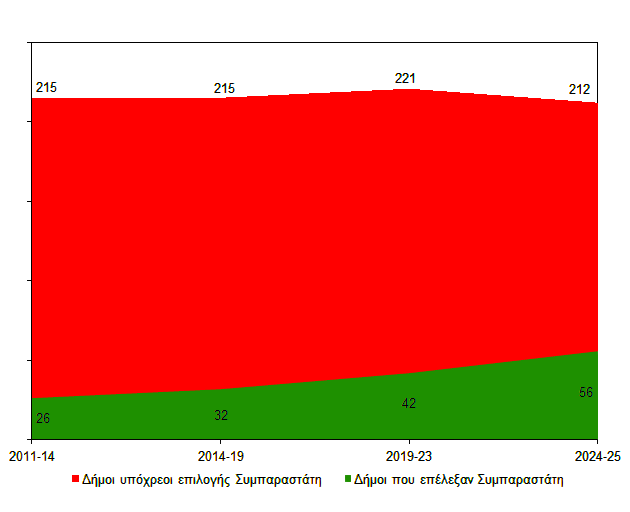
Admittedly, the implementation of the institution of the Citizen's Ombudsman has not been adopted to the expected extent during the first three self-governing periods since its establishment by Law 3852/2010. In the last self-governing period 2019-2023, only 19% of the Municipalities that had to choose a Citizen's Ombudsman actually chose one (i.e. 42 out of 221 Municipalities). In the previous two periods the percentage stood at 15.5% and 20.4% respectively.
Population criteria
According to Law 3852/2010 No. 77 par. 1, the institution of the Ombudsman of the Citizen and the Enterprise is addressed "to municipalities of more than twenty thousand (20.000) inhabitants, as well as to island municipalities". The implementation of the Ombudsman's institution applied for the first time by the Municipal Authorities that began their term of office on January 1, 2011, while in the same year a General Population - Housing Census was carried out by ELSTAT. On the basis of the "New Architecture of Local Government and Decentralized Administration - Kallikratis Program", i.e. Law 3852/2010, which introduced the institution of the Ombudsman into the Greek legal order, the boundaries of local government units were redefined, forming a total of 325 Municipalities. Then, with the division of 5 municipalities into 12 new ones* with the Cleisthenes Program (Law 4555/2018) the number of Municipalities was formed in 332. Of these, 71 Municipalities are islands, excluding the Municipalities of Crete (with the exception of Gavdos) and the Regional Unit of Evia, again in accordance with the Cleisthenes Programme (Law 4555/2018, Art. 2).
*Law 4555/2018 (Cleisthenes I Programme) divided the following Municipalities into young people:
| Old municipality | New municipalities |
|---|---|
| Municipality of Corfu | Municipality of North Corfu
Municipality of Central Corfu and Diapontia Islands |
| Municipality of Kefalonia | Municipality of Argostoli Municipality of Lixouri Municipality of Sami |
| Municipality of Samos | Municipality of Eastern Samos Municipality of West Samos |
| Municipality of Servia - Velvento | Municipality of Velvento |
| Municipality of Lesvos | Municipality of West Lesvos |
The division of four (4) island municipalities into ten (10) young people changed the number of persons obliged to select a Municipal Ombudsman by +6.
The division of the Municipality of Servia - Velvento of the Region of Western Macedonia did not change the number of obligated Municipalities as they were already below the threshold of 20,000 inhabitants before the division.
According to the General Population Census of ELSTAT 2011, the Municipalities of less than 20,000 inhabitants numbered 170, including, of course, most island municipalities (namely 59 out of 71). Thus, the implementation of the Ombudsman's institution was based on the 2011 General Census in order to identify those Municipalities that, on the basis of a population criterion, are obliged to choose an Ombudsman. The data of the 2011 General Census were based on all three Municipal Periods since the adoption of Law 3852/2010 until today. It is also noted that island municipalities were not included in Law 3852/2010 as obligated to choose an Ombudsman, which changed with 4623/2019, where the words "as well as island municipalities" are added to municipalities with more than 20,000 inhabitants (Law 4623/2019, Article 7(2)), implementing the constitutional requirement of protecting insularity (Article 101(4) S.).
The 2021 The General Population Census was carried out again by ELSTAT. Thus, the new Municipal Authorities that take office from 1 January 2024, are expected to take into account the data of the General Census 2021. According to the population changes recorded in the General Population Census of 2021, the Municipalities of less than 20,000 inhabitants now number 178. Specifically, there were 10 Municipalities that fell below the threshold of 20,000 inhabitants (especially the Municipalities Visaltia (peripheral unit), Volvi, Herakleias (peripheral unit), Sintikis, Skydra, Kileler, Meteora, Istiaia - Edipsos, Messina and Pylos - Nestor) and 2 Municipalities (Municipality of Sitia and Municipality of Naxos and Small Cyclades) which got over it. Considering that the Municipality of Naxos and the Small Cyclades was already obliged to select an Ombudsman, as an island, the number of Municipalities that are no longer obliged to select an Ombudsman on the basis of the latest Population Census amounts to 9. Thus, the Continental Municipalities of more than 20,000 inhabitants now amount to 141. If you add to them the 71 islanders Municipalities, then the total number of Municipalities that are obliged to choose an Ombudsman now amount to 212.
See the Municipalities and Regions that had chosen an Ombudsman during the previous three periods:
The Municipalities who chose a Citizen and Business Ombudsman during the Municipal Period 2011-2014 are:
The Regions who selected a Citizen and Enterprise Ombudsman during the Regional Period 2011-2014 are:
All the details of the implementation of the institution by the local authorities are based on the reliability and completeness of the information provided by the Municipalities and Regions, either on their relevant websites or on Di@vgeia. However, the process of researching these sources often revealed that the reliability and completeness of this information is not at all given. Therefore, the information given above may not be entirely accurate.
The Municipalities who chose a Citizen and Business Ombudsman during the Municipal Period 2011-2014 are:
The Regions who chose a Citizen's and Enterprise's Ombudsman during the Regional Period 2014-2019 are:
All the details of the implementation of the institution by the local authorities are based on the reliability and completeness of the information provided by the Municipalities and Regions, either on their relevant websites or on Di@vgeia. However, the process of researching these sources often revealed that the reliability and completeness of this information is not at all given. Therefore, the information given above may not be entirely accurate.
Changes compared to the previous municipal period
A key change for the institution of the Citizen Ombudsman that occurred with Law 4623/2019 is that it included all island municipalities, regardless of population, as obligated to choose an Ombudsman (Law 4623/2019, Article 7, paragraph 2), implementing the constitutional requirement of protecting insularity (Article 101, paragraph 4 S.).
With the Cleisthenes Program (Law 4555/2018) the number of Municipalities was changed from 325 to 332. The split of four (4) island Municipalities to ten (10) young people changed the number of obligated to choose a Municipal Ombudsman by +6. Thus, the total number of Municipalities that are obliged to choose an Ombudsman of the Citizen and the Enterprise amounted to 221.
Another important change comes with Law 4623/2019, which not only abolished the short-lived institution of the Municipal Ombudsman (Law 4555/2018) restoring the institution of the Ombudsman, but also increased the majority required for the election of an Ombudsman. Until then, there was a majority. 2/3 of all members of the Municipal or Regional Council for the election of an Ombudsman, by Law 4623/2019 this majority was changed to 3/5 Members present the municipal or regional council (Law 4623/2019, Article 7(3)-(4)).
The Municipalities who chose a Citizen and Business Ombudsman during the Municipal Period 2019-2023 are:
The Regions who selected a Citizen's and Enterprise's Ombudsman during the Regional Period 2019-2023 are:
All the details of the implementation of the institution by the local authorities are based on the reliability and completeness of the information provided by the Municipalities and Regions, either on their relevant websites or on Di@vgeia. However, the process of researching these sources often revealed that the reliability and completeness of this information is not at all given. Therefore, the information given above may not be entirely accurate.
Changes compared to the previous municipal period
According to the population changes recorded by the 2021 General Population Census, the number of municipalities with less than 20,000 inhabitants now stands at 178. Specifically, there were 10 Municipalities that fell below the threshold of 20,000 inhabitants and 2 Municipalities that exceeded it. Considering that one of the two Municipalities that overcame it is an island (Municipality of Naxos and Small Cyclades) and was already obliged to select an Ombudsman, the number of Municipalities that are no longer obliged to select an Ombudsman based on the latest Population Census amounts to 9. Thus, the Municipalities that are obliged to choose an Ombudsman are now formed in the 212.
Furthermore, in accordance with Article 51(3) of Law 4873/2021, it is clarified that the three-fifths majority (3/5) concerned the municipal period 2019-2023, with paragraph 1 of the same Article reinstating a two-thirds (2/3) majority of all members of the Municipal Council.
The Municipalities who have chosen a Citizen and Business Ombudsman during the Municipal Period 2024-2028:
Municipalities that have an Ombudsman
The Regions who have selected a Citizen’s and Enterprise’s Ombudsman during the 2024-2028 Regional Period:
Regions that have an Ombudsman